
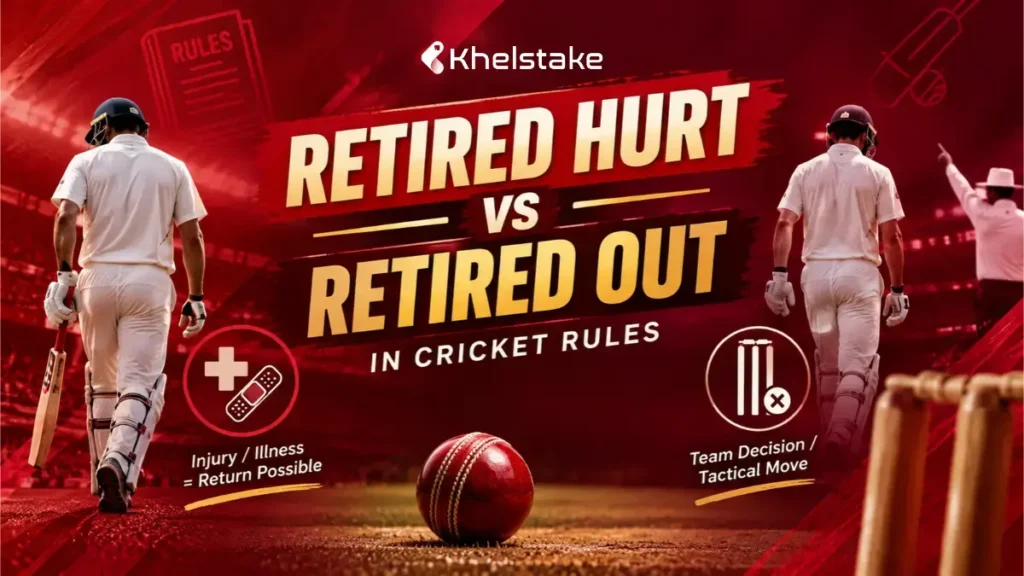
When it comes to retired hurt cricket rules, everything depends on why someone leaves the middle. Walk off with a busted finger or a fever and you’re retired hurt, free to come back in later. Walk off because your captain wants a bigger hitter out there, and you’re retired out, which goes down as a wicket.
From the stands, you’d hardly tell them apart. One person heads for the pavilion, a new face strolls out, and the bowler gets on with it. The scoresheet sees things differently, though. With one, the innings is on hold. With the other, it’s over. Below, you’ll find Khelstake platform cricket experts decode how each works, plus a couple of simple tables for your understanding.
| Retired Hurt | Retired Out | |
|---|---|---|
| Reason for leaving | Body won’t allow it (knock, sickness, emergency) | Team strategy |
| Wicket for the side? | Nope | Yes |
| Written on the card as | Retired not out, if they never return | Retired out |
| Bowler gets anything? | No | No |
| Coming back in | Allowed once the next wicket drops | Needs a yes from the fielding skipper |
Both cases sit under Law 25 of the MCC rulebook. Retired hurt cricket rules falls under 25.4.2, and retired out under 25.4.3.
Picture an opener copping a nasty blow on the forearm in the fifth over. Or a middle-order guy cramping up badly in 40-degree heat. Neither has been dismissed, so neither needs to give up their spot for good. They head off for treatment, and that’s retired hurt cricket rules.
Here’s the nice bit. Their innings stays alive. Whenever the physio clears them, they wait in the dugout until someone else gets out or leaves the field, and then they pad up and walk back on. No asking anyone, no forms to fill in.
Some knocks are too serious when it comes to being retired hurt in cricket. Sometimes the last over arrives before the player is fit. Either way, they finish as “retired not out.” Every run they made still stands, and their average stays safe since nobody actually dismissed them.
| Moment | Result |
|---|---|
| Player picks up a knock mid-innings | Leaves, team keeps all wickets |
| Feels fit again later | Returns after the next dismissal |
| Doesn’t make it back | Card shows “retired not out” |
| Bowling figures | Untouched |
Retired hurt in cricket has nothing to do with pain. A captain simply decides somebody else should be facing. You’ll mostly see retired out near the end of a T20 chase, when one batter is stuck on 20 off 25 and a six-hitter is sitting with pads on, itching to go.
Once that happens, the team gives up a wicket and the player goes down as out in the records. Strangely enough, no bowler gets the scalp. Nobody bowled them or caught anything, after all, so it doesn’t appear in anyone’s figures.
On paper, there’s a way. They’d need the rival captain to agree to it. Realistically, no skipper is handing that kind of favour to the other side, so treat it as a one-way trip.
| Moment | Result |
|---|---|
| Captain wants a quicker scorer | Player leaves by choice |
| Wickets column | One added |
| Player’s stats | Logged as a dismissal |
| Bowling figures | Untouched |
| Getting back in | Only if the other skipper agrees, which basically never happens |
For years, hardly anyone tried it. Then T20 strategy changed, and captains started treating it as one more option.
| Who | Where | When |
|---|---|---|
| Atapattu and Jayawardene | Sri Lanka vs Bangladesh, Test | 2001 |
| Ravichandran Ashwin | RR vs LSG, IPL | 2022 |
| Tilak Varma | MI vs LSG, IPL | 2025 |
When we talk about retired hurt in cricket scenarios Back in 2001, Sri Lanka had Bangladesh so far behind that Atapattu and Jayawardene both went off on purpose so a few teammates could get some time at the crease. In 2022, Ashwin’s walk-off left plenty of fans confused, since nobody in the league had done it before. Three seasons later, Mumbai brought Tilak Varma in during a tight chase, and the call got debated for weeks.
Injury retirements, meanwhile, are everyday stuff. A bouncer to the helmet, a tight calf, a bad bout of cramp. Unless it’s serious, most fans forget about it by the next over.
Twenty overs isn’t a lot. If someone has used up a fair chunk of balls without much to show for it, every dot ball hurts. Swapping them out means giving away a wicket, but some captains feel the faster runs are worth it. Understanding how a run out works also helps explain why captains sometimes take this risk, as a batter who is dismissed this way loses their wicket even if they have scored very few runs.
Of course, it can go wrong. If the replacement nicks off first ball, the side has burned two wickets for almost nothing. It’s also an awkward moment for whoever gets pulled, so most skippers keep it for real emergencies.
Retired hurt cricket rules keeps an injured player’s innings safe until they’re ready again. Retired out is a call by the team, and it costs a wicket. So whenever you see someone leave mid-innings without being dismissed, look at why they went. It’ll tell you which rule is in play in the retired hurt vs retired out debate and whether you’ll see them back out there.For more cricket rules and match insights, explore the latest guides on the Khelstake and build a better understanding of the game.