A no ball looks like a small thing until it happens on the last ball of a close chase. One extra run, one more delivery, and in white-ball cricket a free hit on top. That is why the no ball rules in cricket matter more than most extras.
This guide covers every way a bowler can be called for one, what it costs the fielding side, and when a batter can still get out. It follows the official Laws from MCC, the same set of 42 rules of cricket that umpires use around the world. For more cricket explainers, visit Khelstake.
What Is a No Ball in Cricket?
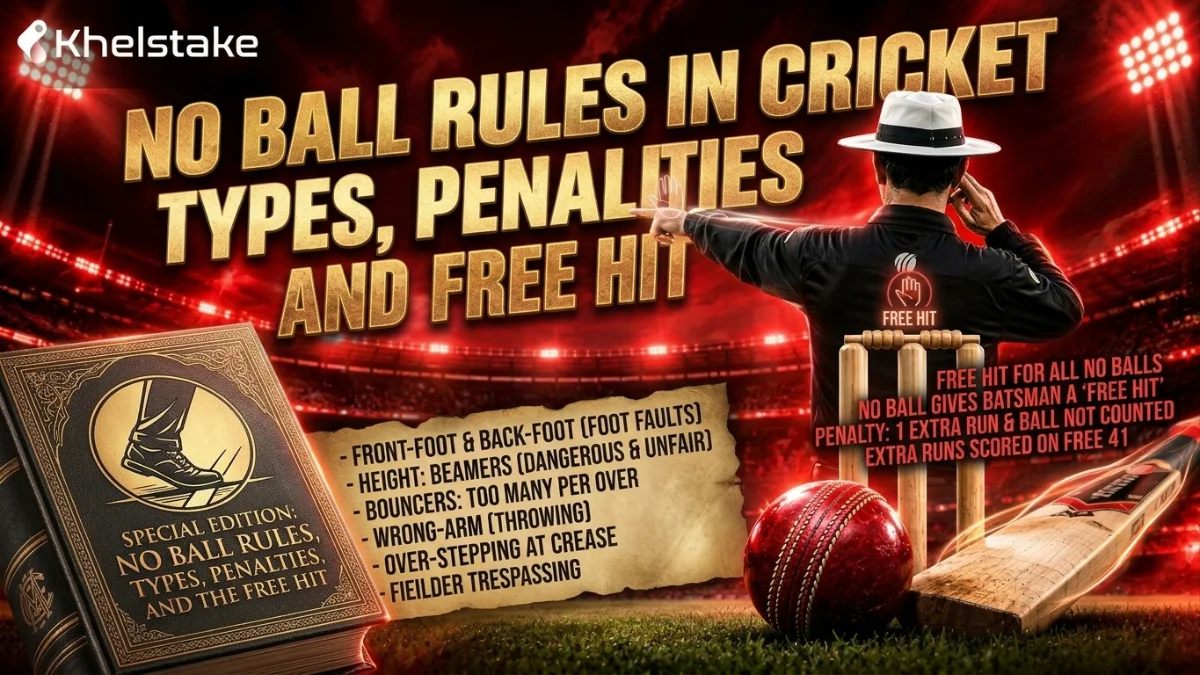
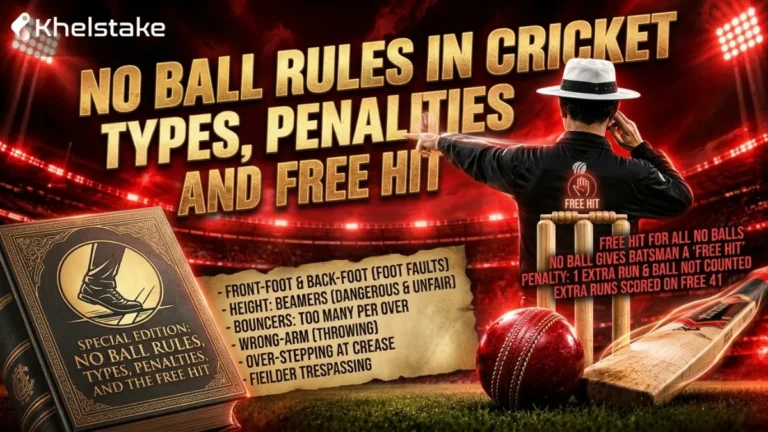
In the game of cricket, no ball is considered an illegitimate delivery made by the bowler which earns the bowling team a 1-run penalty, does not count as a legitimate ball delivered in an over, and gives the batting team a free hit in restricted overs matches like T20 and ODIs.You can read about this in detail on the official MCC site.
The ball does not count as one of the six in the over. So a bowler who sends down three no balls in an over will end up bowling nine deliveries in total.
The Main No Ball Rules in Cricket
There are several ways of bowling a no-ball. Some have to do with the place the feet of the bowler lands, some with the ball itself, and yet others with the place where the fielders position themselves.
Front foot no ball
This is the one you see most. The front foot must land with some part of it, grounded or raised, behind the popping crease. If the whole foot lands beyond the line, it is a no ball. If the foot lands behind the line and then slides over it, the delivery is still legal. Lords
In international cricket, the third umpire now takes up the responsibility of checking for front foot no balls, thus relieving the on-field umpire of that task.
Back foot no ball
The back foot has its own rule. It must land inside the return crease (the line running along the side) without touching it. The front foot also has to land on the correct side of the imaginary line joining the two middle stumps, based on the bowler's stated side of the wicket.
Height no ball rules in cricket
Height is where most arguments start. A full toss that passes above waist height of the batter is a no ball. Umpires also judge pace here. Law 41.7 covers these dangerous high full tosses, which are often called beamers, and slower deliveries are treated differently from fast ones.
Bouncers have their own limits. Under the ICC conditions, a second fast ball above shoulder height in a T20 over is a no ball, while ODIs and Tests allow two in an over. A ball that goes over head height is called a wide, not a no ball. These height no ball rules in cricket depend on the format, so always check the playing conditions of the match you are watching.
Fielding no balls
The fielding side can cause a no ball too. The usual cases are:
- More than two fielders behind square on the leg side at the moment of delivery (Law 28.4). wikipedia
- A fielder moving onto the pitch too early (Law 28.5).
- The wicket-keeper collecting the ball in front of the stumps before it has passed the wicket or touched the bat.
- Breaking the fielding restrictions in white-ball powerplay overs, such as having too few or too many fielders in the wrong zone.
Other no balls
A few less common cases also count. An underarm throw or delivery and a double bounce of the ball constitute a no ball. The rolling ball is a no ball too.Bowling a front foot no ball on purpose is treated as unfair play under Law 41.8. lords
No Ball Penalty: How Many Runs?
The batting side gets one run, added to the team total and charged to the bowler. Some domestic competitions use a different number, but one run is the standard in international cricket.
The batter can also score off the delivery, and those runs count on top of the penalty. A few examples:
| What happens |
Runs added |
| Bowler oversteps, batter misses, no runs taken |
1 (no ball) |
| Bowler oversteps, batter hits a four |
5 (4 off the bat + 1 penalty) |
| No ball, batter misses, keeper misses, batters run 2 |
3 (1 penalty + 2 byes, recorded as no ball extras) |
Free Hit After a No Ball
A free hit is the biggest extra cost of a no ball in limited-overs cricket. Under the ICC rules, the next delivery after any kind of no ball is a free hit for whichever batter is facing. There is no free hit in Test cricket.
How it works:
- The umpire signals it with a circular motion of one arm held straight up, after the usual no ball signal.
- If the free hit itself is a no ball or a wide, the next delivery is also a free hit.
- The fielding captain cannot change the field or swap fielders between positions, apart from a few limited cases.
- The bowler is allowed to change the style of delivery.
- The batter can be out only in the ways allowed on a no ball (see below).
That is why batters swing hard on a free hit. If it goes wrong, it costs them nothing.
Can a Batter Be Out on a No Ball?
Yes, but only in three ways. Under Law 21.18, a batter cannot be out on a no ball except by hit the ball twice, obstructing the field or run out.
| Dismissal |
Out on a no ball? |
| Run out |
Yes |
| Hit the ball twice |
Yes |
| Obstructing the field |
Yes |
| Bowled |
No |
| Caught |
No |
| LBW |
No |
| Stumped |
No |
| Hit wicket |
No |
Run out is by far the most common one in practice. A batter hits the ball, sets off for a quick single, and gets caught short by a direct hit.
No Ball vs Wide Ball
Both of these balls are considered extras, and both require that the ball be delivered once again. However, they are different from each other. A wide is a ball too far from the batter to reach. A no ball is an illegal delivery. If a delivery is both, the no ball takes priority over the wide.
|
No ball |
Wide |
| Penalty |
1 run |
1 run |
| Free hit |
Yes (white-ball) |
No |
| Batter can be bowled or caught |
No |
Yes, in some cases |
| Bowler's mistake |
Overstepping, height, illegal action |
Too wide or too high |
How Umpires Signal a No Ball
The umpire stretches one arm out horizontally to the side and calls "no ball". In white-ball cricket, this is followed by the free hit signal. The scorers and the batters should both see it.
Conclusion
The no ball rules in cricket come down to a short list: feet, height, fielders and a few unusual cases. The cost is one run and one more ball, and in white-ball cricket a free hit as well. Keep the "out only in three ways" rule in mind and you will understand most no-ball decisions you see on TV. Follow more rule guides and match explainers on Khelstake.
FAQs
How many runs do you get for a no ball?
One run is added to the batting team's total, plus any runs scored from the delivery.
Is there a free hit in Test cricket?
No. Free hit is applicable only for limited-overs games like ODIs and T20s.
Can a batter be bowled on a no ball?
No. A batter cannot be bowled, caught, LBW, stumped or hit wicket on a no ball. Only run out, hit the ball twice and obstructing the field apply.
Is a bouncer a no ball?
Only if it breaks the bouncer limit for the format, or if the umpire judges it dangerous. Anything above head height is called a wide instead.
Where can I read the official no ball rules in cricket?
Law 21 on the MCC website, and the ICC playing conditions for the free hit and format rules.