
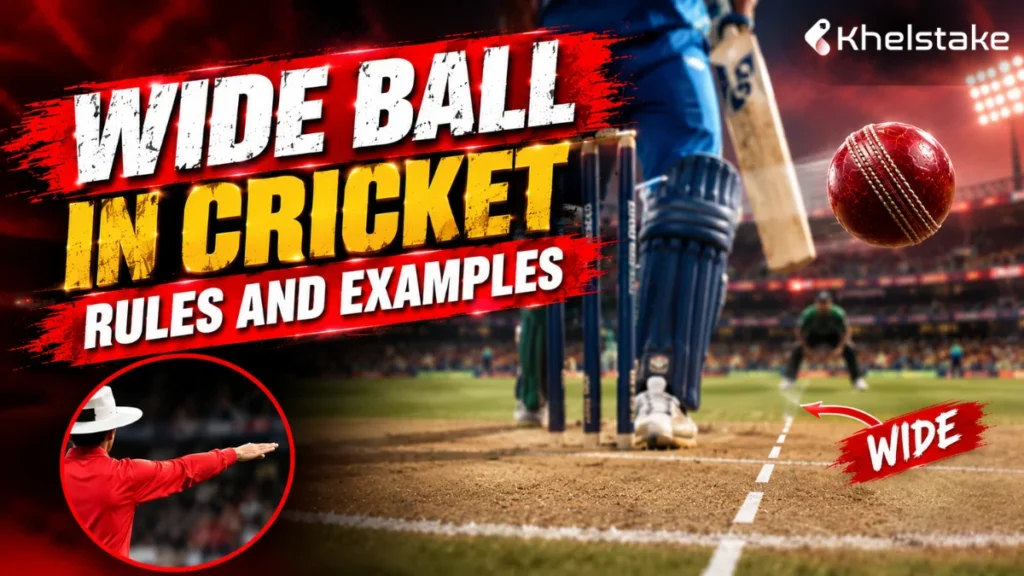
In case of a wide being declared by the umpire, it merely indicates that the batsman did not have any opportunity to reach out for the ball. A run is awarded to the batting side and the bowler delivers another delivery. This entire concept is related to the law of wide ball in cricket rules, including those formed in 2026.
Mixing wides up with no balls is easy, so those get their own guide on no ball rules in cricket. More rule explainers live on the Khelstake platform.
Short answer: it’s a ball the batter couldn’t reach with a normal shot. Law 22 of the MCC Laws covers it (Law 22.1.2).
Umpires also take note of the striker’s position when the ball leaves the bowler’s hand. A normal stance counts too. The wording arrived in 2022, and it stops batters from shuffling across early to turn a ball wide.
One more thing: a wide doesn’t use up a ball in the over. He throws it once again.
This would depend on three aspects: distance, height, and movement of the batsman.
The call happens as the ball crosses the striker’s stumps. A delivery made by the batsman can look like a wide from the start, but the umpires usually wait till the ball passes a batter before they show any signs.
This is the headline change. The 2026 edition kicked in on 1 October 2026. Now a ball over an upright batter’s head at the popping crease is a wide (Law 22.1.3). Older editions called it a no ball (Law 21.10).
International cricket was already doing it this way, so TV audiences won’t notice anything different.Not every guide reflects the latest rules. Take a moment to check its date before relying on the information.
White-ball cricket has its own leg-side rule from the ICC. Umpires measure from where the batter’s legs are when the bowler lets go. Even if the batsman moves to the offside, the measurement is taken from the same reference point. Check the ICC regulations for the precise statement.
A wide doesn’t always stand. Four situations cancel it or block the call:
Every wide adds one run to the batting team's total. Anything the batters run comes on top, and so does a boundary. The scorebook is where most mix-ups happen. According to Law 22.7, the wide extra, any runs completed by the batters, and boundary runs are all recorded as wides charged to the bowler. Nothing goes down as byes.
| What happens | Runs added | Scorebook entry |
|---|---|---|
| Batters do not run | 1 | 1 wide |
| Batters run 2 | 3 | 3 wides |
| Ball reaches the boundary | 5 | 5 wides (4 plus 1 extra) |
Bat runs never happen on a wide, since touching the ball with bat or body cancels the call (Law 22.3). Even if the batter is stumped off that delivery, the wide extra still counts (Law 22.6). And forget about a free hit. Those only come after a no ball.
A wide signal doesn’t make the batter safe. The ball is live throughout the game, and there are only four ways that a batsman can be dismissed: stumping, run-out, hit wicket, and obstructing the field.
| Dismissal | Out on a wide? |
|---|---|
| Stumped | Yes |
| Run out | Yes |
| Hit wicket | Yes |
| Obstructing the field | Yes |
| Bowled | No |
| Caught | No |
| LBW | No |
| Hit the ball twice | No |
Stumped is the big one. A batter skips down the pitch and misses a wide one. The keeper breaks the stumps before the back foot gets home.The umpire will show wide but the batsman will still walk.: stumped drops out, and hit the ball twice comes in.
Both are extras. Both give one run. Both mean the bowler goes again. When one delivery is both, the no ball call takes over (Law 21).
| Wide | No ball | |
|---|---|---|
| Cause | Ball beyond the striker’s reach, or over head height | Overstepping or another illegal delivery |
| Extra run | 1 | 1 |
| Counts as one of the six | No | No |
| Free hit next ball | No | Yes (ODIs and T20Is) |
| Scored as | All wides | No ball extra, plus bat runs or byes |
| Batter out by | Stumped, run out, hit wicket, obstructing the field | Run out, hit the ball twice, obstructing the field |
The batsman has both his arms extended outward. The umpire declares “wide.” It must be detected by the batsman and scorer before the next ball.
One extra run, plus whatever the batters run. Scorers log all of it as wides.
Yes. The ICC already worked this way, and the MCC Laws caught up on 1 October 2026 (Law 22.1.3).
No. Free hits follow no balls only.
No. Only stumped, run out, hit wicket, and obstructing the field apply.
So the wide ball in cricket rules come down to reach, height, and movement. Out of range or over the head, it’s a wide. The batting side gets a run and the bowler goes again. Stumped and run out stay possible. Keep the 2026 head-height change in mind and most wide calls on TV will make sense. More rule guides are waiting on Khelstake.