
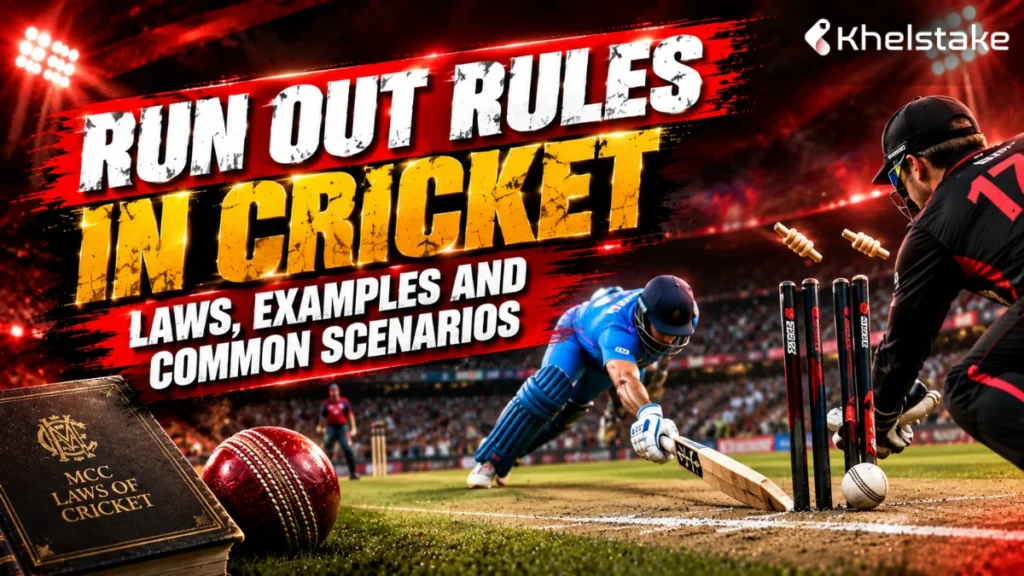
Run out rules in cricket come down to one idea.A batter is out of their ground if neither their person nor their bat is grounded behind the popping crease when the wicket is fairly broken. The ball must be in play, and the dismissal must satisfy Law 38 of the MCC Laws of Cricket. The bowler gets no credit, and a run attempt is not always needed.
A run out in cricket happens at the popping crease, a white line four feet in front of the stumps. If nothing from the batter or bat touches the ground behind the line, the batter is out. A fair break of the wicket then ends the batter's innings.
Most run outs come from a quick single. A batter sets off, a fielder gathers the ball, and a throw hits the stumps before the bat lands. Still, running is not a requirement. A batter drifting down the pitch after a shot also risks a close fielder’s quick break.
Three things must all be true for the rules of run out in cricket to apply:
The batter whose ground sits at the broken stumps is the one who walks, as Law 38.4 states. Scoring follows a clear pattern. Runs already completed stay on the board, but the run in progress does not count. Say a batter finishes two runs and falls short on the third. The score keeps two. Penalty runs also stay.
The bowler gets no wicket in the figures. The credit belongs to the fielders who made the dismissal.
Mix-ups between partners cause many dismissals. Law 30.2 decides whose ground is whose, and this settles the confusing cases.
On the line run out rules in cricket confuse plenty of fans. Under MCC Law 7.3, the popping crease is defined by the back edge of the marked line, away from the opposite end of the pitch. Law 30.1.1 states that some part of the batter’s bat or person must be grounded behind the popping crease to remain within their ground. Simply touching the painted line is not enough.
Timing matters too. Umpires look at the exact instant the stumps break. A batter who grounds the bat and lifts it afterward stays safe. A bat hanging in the air at the instant means the batter is out. Running or diving toward the crease is the one exception. This is Law 30.1.2.
MCC clarified the rule following the controversial run-out of Pakistan opener Muneeba Ali against India in the 2025 Women’s Cricket World Cup. Although Muneeba had grounded her bat inside the crease earlier, it was in the air when the wicket was broken. Law 30.1.2 did not protect her because she was neither running nor diving towards her ground at that moment. MCC confirmed that the third umpire’s decision to give her out was correct.
Law 38 lists a few safe cases:
Under MCC Law 38.3, a non-striker who leaves their ground early can be run out before the bowler releases the ball. This applies from the moment the ball comes into play until the point when the bowling arm reaches the highest point of its normal action in the delivery swing. The bowler does not need to give a warning before attempting the dismissal.
Run out rules in cricket reduce to three checks: a live ball, a batter outside the ground and a fair break of the wicket. Know those, and the replays make sense. For simple explainers and everyday cricket news, keep following Khelstake.
Yes. Law 38.1 applies even when a no-ball is called. A run out is possible on a wide as well.
No. The ball must be live. A batter who leaves the crease, wrongly thinking the ball is dead, still faces a run out on appeal.
Whose contribution does a run out give credit to?
It gives credit to the primary fielder, which is the player that collects the ball and then breaks the wicket or passes the ball to another player. Other players who touch the ball also get credit.
Can the fielding team captain withdraw an appeal for a run out?
Yes. Law 31.8 allows the captain to withdraw an appeal, and usually the spirit of the game makes the decision. One such case happened in 1996 between Fanie de Villiers and Sourav Ganguly.
No. A fielder who holds the ball in hand and pulls a stump out of the ground also breaks the wicket.