
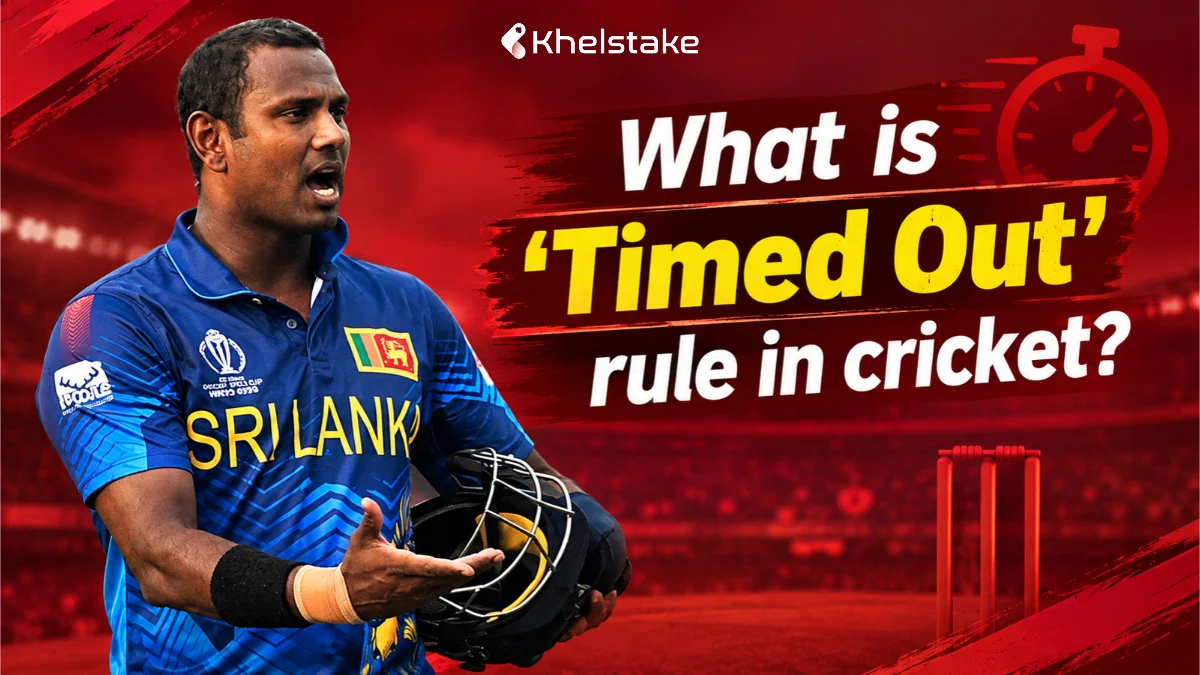
The time out rule in cricket time out rule in cricket says an incoming batter is out if they are not ready to face the next ball within a fixed time after a wicket falls or a batter retires. Under the MCC Laws, the limit is three minutes.
ICC playing conditions cut it to two minutes in Tests and ODIs and to 90 seconds in T20Is. On the Khelstake platform, it turns up in live scorecards only once in a long while, and when it does, people talk about it for days.
Law 40 of the MCC Laws is where the timed out rule in cricket lives. Clause 40.1.1 gives the next batter three minutes from the fall of a wicket, or a retirement, to be ready for the next ball. It also counts if the partner at the other end is set to face instead. Miss the window, and the fielding side has grounds to appeal.
Walking onto the field, or even reaching the crease, does not satisfy the rule. The batter has to be in position to take guard, with pads, gloves and helmet on.
Much like a run out in cricket, a timed out dismissal does not count toward the bowler’s figures. Law 40.2 states the bowler gets no credit for the wicket. It shows on the scorecard but adds nothing to any bowler’s tally.
The time out rule in cricket changes depending on who sets the regulations. The MCC writes the Laws, while the ICC writes playing conditions for international matches. Where the two differ, the ICC version of the time out rule in cricket applies.
Ninety seconds suits T20, where a whole innings lasts around 90 minutes. Many T20 venues seat waiting batters in dugouts by the rope to save walking time.
Domestic competitions write their own version, and it varies. As a result, Khelstake readers checking a specific tournament should look at its published rules first.
Umpires never apply the timed out rule in cricket on their own. Instead, the fielding side must appeal. Without an appeal, play carries on, even if the clock has run past the limit.
The time out rule in cricket also has clear exceptions. If the umpires have called Time, the clock stops. Similarly, if safety equipment breaks and the batter tells the umpires straight away, they have room to allow extra time. The key detail is telling the umpires. A wave toward the dressing room does not count.
Law 40.1.2 deals with a rarer case, where nobody walks out at all. If the delay drags on, the umpires turn to Law 16.3 and award the match to the fielding side.
International cricket went decades without a single timed out dismissal, even though the timed out rule in cricket was in the book the whole time. Then came Sri Lanka against Bangladesh at the 2023 Men’s World Cup, played in Delhi on 6 November.
Mathews came in after Sadeera Samarawickrama’s wicket. The MCC’s later review found he took more than 90 seconds to get as far as the 30-yard circle. At the crease, his helmet strap gave way. He waved to the dressing room for a new one.
Shakib Al Hasan, Bangladesh’s captain, appealed. Since more than two minutes had passed and Time had not been called, the umpires gave Mathews out. He became the first batter in international cricket history to be dismissed under the time out rule in cricket.
The decision split opinion. Mathews argued the faulty helmet caused the delay. On the other hand, the MCC later said the strap broke 1 minute and 54 seconds after the previous wicket fell, and it backed the umpires. It added Mathews might have avoided the dismissal by alerting the umpires at once.
Bangladesh took the game by three wickets. The MCC listed only six earlier timed out dismissals in first-class cricket. On Khelstake, it remains the go-to example whenever this law comes up.
Most of the risk sits with the next batter in. With pads on, gloves in hand and every helmet strap checked before the wicket falls, the time out rule in cricket stops being a worry.
For fans, the time out rule in cricket explains rare moments like the Mathews incident. Khelstake breaks down rules like this one in plain language, so the next odd decision makes sense faster. Keep the Khelstake cricket rules section bookmarked, and check Khelstake when something strange happens during a live match.