
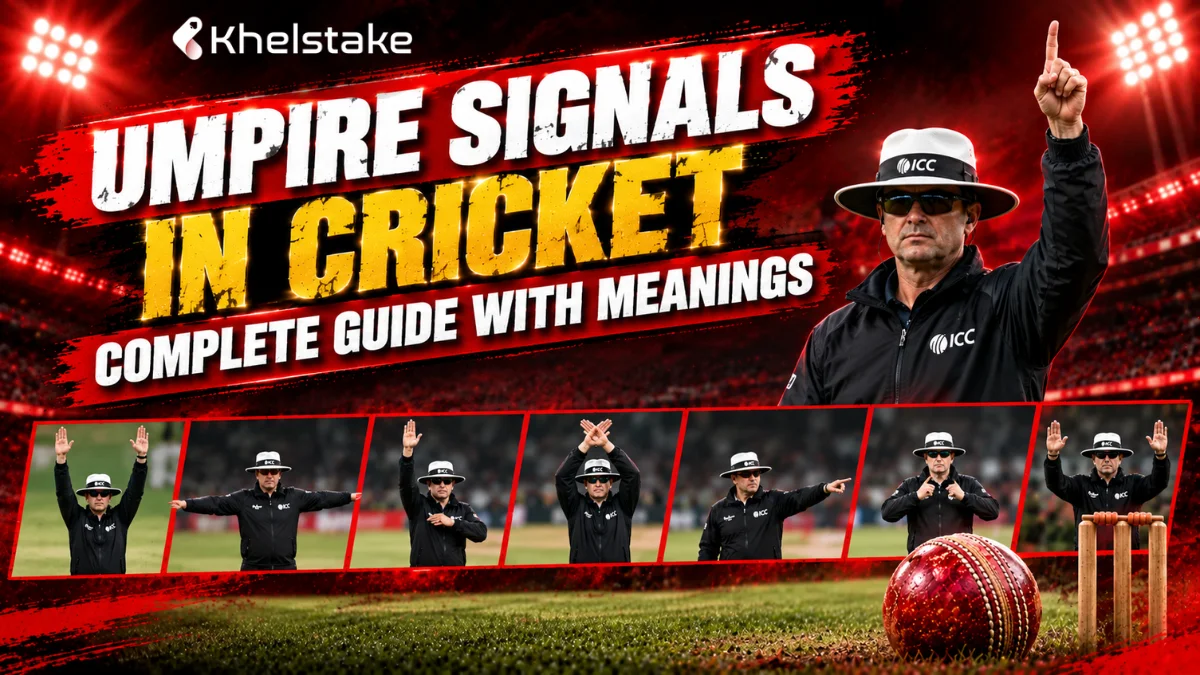
Umpire signals in cricket are the hand gestures an umpire uses to announce a decision without saying a word. One finger up means out. Both arms up means six. A single arm stretched level to the side marks a no-ball. The Khelstake platform covers every signal in this guide, along with the rules behind them. You will also find a review guide, an example overview, and a list of common mix-ups. The rules for a no-ball get a closer look in the extras section.
The playing field is large, and the crowd can never be silent. The announcement made by an umpire in the middle may not reach the ropes around the field. This problem is solved by using gestures because everyone seated in the ground will be able to see them. Everybody understands the same gesture in exactly the same way, thus making the umpire's gestures in cricket uniform everywhere.
| Group | Why they need the signals |
|---|---|
| Players | Crowd noise drowns out a spoken call |
| Fans | Big grounds put most of the crowd far from the middle |
| Scorers | Every extra, boundary and dismissal goes on the scoresheet |
| TV viewers | The gesture explains a decision before the replay arrives |
Most matches have two umpires on the field. The first takes a spot behind the stumps at the end the bowler runs in to. The second watches from the leg side, square on to the crease. This spot gives a side view of the batter. They swap roles after every over. Test matches add two more officials off the field. A third umpire watches video replays, and a fourth looks after the match balls.
The bowler’s end umpire makes most of the decisions during play, so this umpire gives most signals. Even so, either umpire gives umpire signals in cricket when the moment calls for it.
| Official | Where they are | What they do |
|---|---|---|
| Bowler’s end umpire | Behind the stumps at the non-striker’s end | Watches the line of the pitch and gives most signals |
| Striker’s end umpire | Usually at square leg | Gets the best view of the batter and moves if a fielder blocks it |
| Third umpire | Off the field, with video replays | Checks run outs, stumpings, boundaries and close catches |
| Fourth umpire | Off the field, in Test matches | Looks after the match balls |
| Match referee | Off the field | Enforces the ICC code of conduct and makes no calls on play |
Start with the big three. They decide the score and the fate of every batter.
| Signal | What the umpire does | What it means |
|---|---|---|
| Out | Raises one index finger above the head | The batter is dismissed |
| Four | Move one arm left and right across the body in front of the body | Four runs have been scored since the ball has gone out of the field after bouncing |
| Six | Move both arms above the head | The ball has gone out of the boundary without bouncing |
Most fans pick up the out signal before any other of the umpire signals in cricket. Everyone knows about it. The umpire lifts a lone index finger over the head. This is the same signal for all the methods of getting out a batsman. The fielding side must appeal first. Then the umpire replies, either by raising the finger or by calling not out.
Two more umpire signals in cricket show boundaries. The difference between a four and a six comes down to one bounce. A ball which touches the ground before the rope earns four. A ball which clears the rope on the full earns six. Extras come first when both happen together. A no ball which also reaches the boundary gets the no ball signal first, then the four.
Extras are runs from somewhere other than the bat. Scorers record these through five umpire signals in cricket, shown below.
| Signal | What the umpire does | What it means |
|---|---|---|
| No ball | Extends one arm sideways, level with the shoulder | The delivery was illegal, such as an overstepped crease. The batting side gets a run and the ball is bowled again |
| Wide | Holds both arms straight out to the sides | The ball passed out of the batter’s reach. The batting side gets a run and the ball is bowled again |
| Bye | Holds one open hand high above the head | Batters took runs after the ball beat the bat and the body. The runs count as extras |
| Leg bye | Taps a raised, bent knee with the hand | The ball touched the batter’s body and missed the bat. The runs count as extras |
| Free hit | Circles one raised hand above the head | The next ball is a free hit after certain no balls |
Extending a single arm sideways, the umpire declares a no ball. The batting side gets one run, and the delivery does not count among the six balls of the over. The over then needs another delivery to reach its six legal balls. The most common reason is the front foot landing beyond the popping crease. A back foot outside the return crease also earns the call. A ball arriving above waist height without a bounce earns it too. Dangerous short-pitched bowling is a fourth.
The umpire stretches both arms out and calls wide. The ball passed too far from the batter to be struck. The batting side gets one run, the delivery does not count in the over, and the bowler bowls again. Scorers charge every wide to the bowler.
An open hand goes up high over the umpire’s head. The ball missed the bat and the batter’s body, yet the batters ran. Those runs go down as byes. When the ball runs all the way to the rope, the batting side takes four byes. In modern scoring, byes count against the wicketkeeper and not the bowler.
The umpire touches a raised knee. The ball hit the batter’s body, and the batters ran. A leg bye only counts if the batter tried to play the ball or tried to avoid it. The batter also must not be out LBW. A glove on the bat handle counts as part of the bat. Runs off the glove go to the batter, not to the leg byes. Leg byes never count against the bowler.
The umpire circles a raised hand above the head. The next ball is a free hit in limited-overs matches. The batter is safe from most dismissals on this ball. Only a run out, hitting the ball twice or obstructing the field ends the innings. Bowled, caught and LBW do not apply.
The rarer umpire signals in cricket come next. Scorers and officials use every one of them.
| Signal | What the umpire does | What it means |
|---|---|---|
| Dead ball | Crosses and re-crosses the wrists below the waist | The ball is out of play. No runs or dismissals follow |
| Short run | Bends one arm and touches the shoulder with the fingertips | A batter missed the crease, so the run does not count |
| Penalty runs | Moves a hand across the chest to the opposite shoulder | A tap awards the runs to the batting side. A held hand awards them to the fielding side. The usual award is 5 runs |
| Cancel call | Crosses both arms over the chest, each hand on the opposite shoulder | The umpire withdraws the last signal |
| New ball | Holds a ball high above the head | A new ball comes into play |
| Last hour | Raises one hand and points to the raised wrist with the other | The last hour of a multi-day match has started |
The dead ball signal stops everything. After it, no runs score and no batter is out. The short run signal is a quiet one. The umpires watch the creases, and a batter who fails to ground the bat inside the crease loses the run.
Penalty runs deserve a closer look. Umpires award them under the Laws on unfair play and players’ conduct. Five runs go to the other side after serious misconduct. A more common case is the ball striking a helmet on the field. The direction of the gesture shows who receives the runs. A tap on the shoulder means the batting side, and a hand held still means the fielding side.
The cancel call fixes mistakes. An umpire who signals in error crosses both arms over the chest. The corrected signal follows. The new ball signal ties into match length. In first-class cricket, the fielding side gets the option of a new ball after 80 overs. The last hour signal marks the final stretch of a multi-day match.
Some decisions leave the on-field umpire’s hands. Review gestures are the newest umpire signals in cricket, and two of them matter. The umpire draws a box in the air with both hands to refer a decision to the TV umpire. A player asks for a review with a T shape. Both arms or an arm and the bat form it.
The Decision Review System, or DRS, sets clear limits on reviews. Only the dismissed batter or the fielding captain gets to ask. The request must come within about 15 seconds of the decision. Teams have a fixed number of unsuccessful reviews per innings.
| Format | Unsuccessful reviews per team, per innings |
|---|---|
| Tests | 3 |
| ODIs | 2 |
| T20Is | 2 |
The third umpire checks the footage. The verdict says whether it supports the call, contradicts it or settles nothing. Only a clearly wrong call changes. The on-field umpire then reverses it by crossing the hands on the shoulders and giving the corrected signal. If the footage is inconclusive, the original call stands. For LBW calls, a close decision falls under umpire’s call. The original decision stays, and the team keeps its review.
The system has a short history. It launched on 24 November 2009 in a Test between New Zealand and Pakistan at Dunedin. It reached ODIs in January 2011 and a T20I event at the 2014 World T20.
There are many other cricket umpire rules apart from signalling. This table shows the pattern behind the umpire signals in cricket for extras.
| Extra | Runs added | Counts as a legal ball | Charged to the bowler |
|---|---|---|---|
| Wide | 1 | No | Yes |
| No ball | 1 | No | Yes |
| Bye | Runs completed, or 4 at the boundary | Yes | No |
| Leg bye | Runs completed, or 4 at the boundary | Yes | No |
Umpires also count deliveries and announce the end of every over. Miscounts happen, so scorers speak up when their tally disagrees. The Laws of Cricket, maintained by the MCC, hold all these rules.
Watching live is the best practice. Look at the bowler’s end umpire first, since this umpire gives most signals. Then wait for a second gesture.
Extras often come with a follow-up, such as a no ball and then a four. The scorers’ box also helps. Scorers must acknowledge each signal, so a short pause often follows a signal. With a few overs of practice, the umpire signals in cricket start to feel automatic.
The gestures stay the same in every format. What changes is how often each one appears. The table lists the main differences.
| Item | Multi-day matches | Limited-overs matches |
|---|---|---|
| Free hit signal | Not used | Used after certain no balls |
| Last hour signal | Used | Not needed |
| Reviews per team | 3 per innings in Tests | 2 per innings |
The sample over below shows umpire signals in cricket at work. It is invented and does not come from a real match.
| Delivery | What happens | Signal | Runs |
|---|---|---|---|
| 1 | Batter pushes a single | None | 1 |
| 2 | Ball lands far outside off stump | Wide | 1 |
| 3 | Ball misses bat and body, batters run two | Bye | 2 |
| 4 | Ball clips the pad, batters run one | Leg bye | 1 |
| 5 | Bowler oversteps, batter drives to the boundary | No ball, then four | 5 |
| 6 | Free hit, batter clears the rope on the full | Free hit, then six | 6 |
| 7 | Batter blocks | None | 0 |
| 8 | Batter takes a single | None | 1 |
The over totals 17 runs from eight deliveries. Only six of those deliveries count as legal, because the wide and the no ball do not.
Some gestures look alike. The table below shows how to tell them apart.
| Pair | How to tell them apart |
|---|---|
| Bye and six | A bye uses one open hand. A six uses both arms |
| Wide and no ball | A wide uses both arms out sideways. A no ball uses one |
| Leg bye and short run | A leg bye taps the knee. A short run touches the shoulder |
| Short run and penalty runs | A short run uses fingertips on the same shoulder. Penalty runs cross the chest to the opposite shoulder |
| Dead ball and cancel call | A dead ball crosses the wrists below the waist. A cancel call crosses the arms over the chest |
Skip the long chart. Match each clue to one of the umpire signals in cricket instead.
| Clue | Signal |
|---|---|
| One arm out sideways | No ball |
| Two arms out sideways | Wide |
| Two arms straight up | Six |
| Open hand held high | Bye |
| Tap on the knee | Leg bye |
| Touch to the shoulder | Short run, penalty runs or cancel call |
Umpire signals in cricket look odd at first, then they click. Tie each gesture to one result and most calls make sense at a glance. For more cricket-related insights and briefs, check out Khelstake.
They are standard gestures from the on-field umpires. Scorers acknowledge each one with a light or a towel, and play waits for the acknowledgement.
No. The ICC dropped it from 1 June 2023, starting with the World Test Championship final. Umpires now send a close call straight to the TV umpire without giving their own view first.
Often, yes. Umpires usually call out no ball, wide ball, dead ball and one short while they gesture. The words help players hear the decision, and the gesture helps everyone else.
Usually the umpire says not out and shakes the head. After a review overturns an out call, the umpire crosses the hands horizontally in front of the waist three times.
The official gesture is one raised index finger. Some umpires add their own style, such as Billy Bowden’s crooked finger or Rudi Koertzen’s slow raise. The meaning stays the same.