Fastest Century in Test Cricket: Top 10 Record-Breaking Knocks
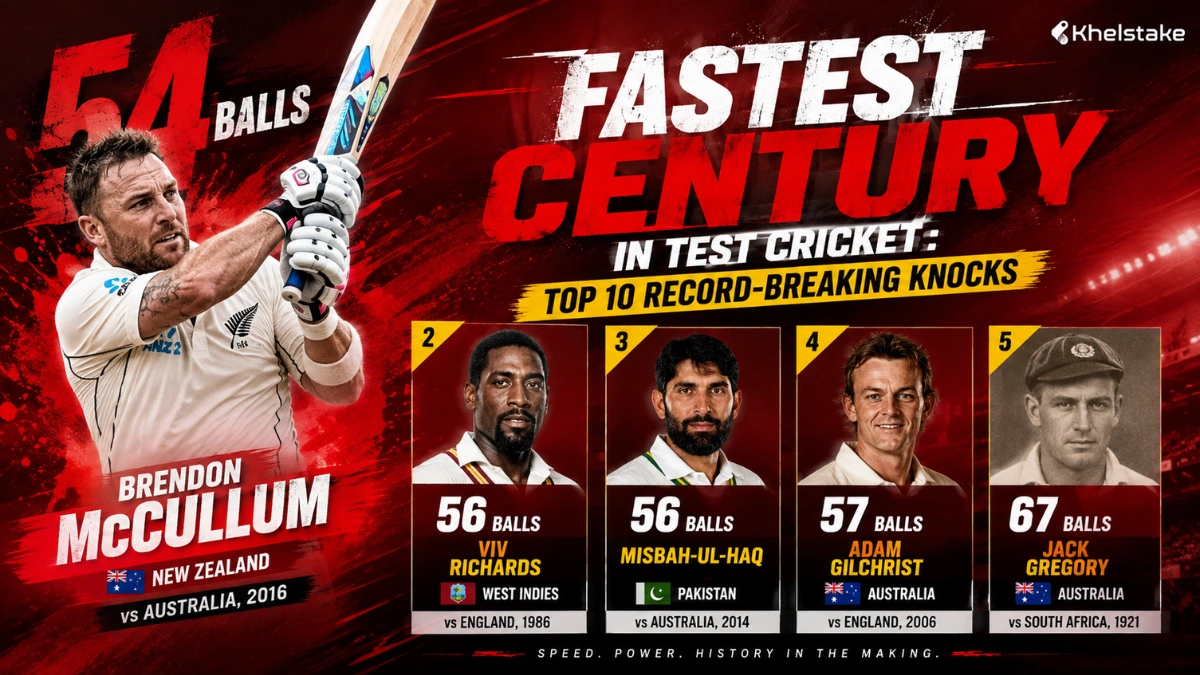
Brendon McCullum owns the fastest century in test cricket, reaching 100 from 54 balls. Thus, he achieved this landmark against Australia at Christchurch’s Hagley Oval during 2016.
His farewell Test innings transformed a difficult New Zealand position into attacking momentum. Moreover, McCullum’s breathtaking strokeplay proved Test batting can shift dramatically within minutes.
Every cricket century demands skill, yet this record demanded extraordinary intent and timing. Khelstake brings cricket followers closer to such memorable Test milestones and batting achievements.
What Is the Fastest Century?
The fastest century in test cricket measures balls faced before reaching 100 runs. Therefore, runs per minute do not determine this particular batting record.
In addition, McCullum scored his century in 54 balls, breaking two previous records of achieving a century in 56 balls. Additionally, Viv Richards and Misbah-ul-Haq were sharing the record of being the fastest centurion in different eras.
Consequently, this milestone was achieved in the 101st and last Test match for McCullum. In this way, it is evident that this achievement had much historical significance to him.
Top Fastest Test Centuries
The following table ranks the quickest Test hundreds through balls faced. Therefore, tied positions create eleven players across the leading ten ranking places.
| Rank |
Player |
Team |
Opponent |
Balls |
Year |
| 1 |
Brendon McCullum |
New Zealand |
Australia |
54 |
2016 |
| 2 |
Viv Richards |
West Indies |
England |
56 |
1986 |
| 3 |
Misbah-ul-Haq |
Pakistan |
Australia |
56 |
2014 |
| 4 |
Adam Gilchrist |
Australia |
England |
57 |
2006 |
| 5 |
Jack Gregory |
Australia |
South Africa |
67 |
1921 |
| 6 |
Shivnarine Chanderpaul |
West Indies |
Australia |
69 |
2003 |
| 7 |
David Warner |
Australia |
India |
69 |
2012 |
| 8 |
Travis Head |
Australia |
England |
69 |
2025 |
| 9 |
Chris Gayle |
West Indies |
Australia |
70 |
2009 |
| 10 |
Roy Fredericks |
West Indies |
Australia |
71 |
1975 |
Historical scorecards recognise Gregory’s 67-ball hundred and Fredericks’ 71-ball effort. Therefore, cricket’s record books also confirm Majid Khan’s 74-ball century against New Zealand.
Brendon McCullum’s 54-Ball Masterclass
The fastest century in Test cricket came during New Zealand’s second Test against Australia. In general, McCullum arrived when New Zealand struggled at 32 for three wickets.
However, he immediately attacked Australia’s bowlers with fearless and clean boundary hitting. Thus, he scored 16 fours and 4 sixes before scoring his historic century. In addition to that, McCullum scored 145 runs in just 79 balls.
Additionally, the total run was achieved through 21 fours and 6 sixes. McCullum’s century took approximately 78 minutes, adding another layer to its brilliance. Additionally, he managed to break the record on his last international appearance for New Zealand.
Moreover, he contributed 179 runs for the fifth wicket along with Corey Anderson. This particular innings was scored at an astonishing pace of 9.76 runs per over. Consequently, Khelstake platform users can revisit why this knock remains Test cricket’s speed benchmark.
Other Record-Breaking Centuries
Viv Richards and Misbah-ul-Haq
Viv Richards made his 56-ball hundred against England in Antigua during 1986. His innings held the outright record until Misbah matched it decades later.
Additionally, Misbah’s acceleration showed his usually composed approach could become devastating. Both players held the record before McCullum reduced their mark by two deliveries.
Adam Gilchrist and Jack Gregory
Adam Gilchrist reached three figures from 57 balls against England at Perth. His 2006 innings placed Australia in an overwhelmingly strong Ashes position. Meanwhile, Jack Gregory’s 67-ball century arrived against South Africa during 1921.
Thus, Gregory’s remarkable effort occurred on a matting wicket in Johannesburg. His record lasted for roughly 65 years before Richards eclipsed it.
Chanderpaul, Warner and Fredericks
Shivnarine Chanderpaul struck a 69-ball hundred against Australia in Georgetown. Usually patient, Chanderpaul surprised observers through relentless attacking strokeplay.
Furthermore, David Warner later matched that 69-ball mark against India at Perth. Warner became the fastest Australian Test opening centurion through that innings.
Hence, Roy Fredericks completed his hundred from 71 balls against Australia at Perth.
Therefore, Perth features prominently among cricket’s most explosive Test batting performances.
Majid Khan, Kapil Dev and Azharuddin
Majid Khan reached his 74-ball hundred before lunch against New Zealand. That Karachi innings remains among Test cricket’s rare opening-session centuries. Kapil Dev then equalled India’s fastest mark against Sri Lanka at Kanpur.
Moreover, Mohammad Azharuddin later matched Kapil’s 74-ball achievement against South Africa. These efforts hold special importance within india test cricket records today. Azharuddin completed his hundred during India’s 1996 Kolkata Test against South Africa.
Fastest Indian Test Centuries
India’s fastest Test-century list contains attacking specialists from several distinct generations.
Further, Kapil Dev and Azharuddin together top the list of the Indians who have scored hundreds off 74 balls. Sehwag comes close, scoring his quickest Test hundred in 78 balls. The achievement was made against West Indies in Gros Islet in 2006.
Thus, Shikhar Dhawan too made an impressive hundred in 85 balls against Australia. Consequently, Indian batters have repeatedly mixed classical patience with decisive attacking intent.
Also, Khelstake registration can help supporters follow major cricket stories through one familiar destination.
How Rare Are Fast Hundreds?
A normal Test century often develops over several sessions through calculated batting. Thus, a fast century requires boundary opportunities, confidence, favourable conditions, and urgent circumstances.
Record-breaking hundreds need all those factors alongside exceptional execution under sustained pressure.Moreover, captain
sometimes encourage acceleration when declarations or recoveries become necessary.
Moreover, bowlers also face fewer defensive fields when batters attack from the opening delivery. Thus, the fastest century in test cricket therefore represents more than simple high scoring.
Speed Versus Career Greatness
A rapid hundred measures delivery count, not a batter’s complete Test career. In contrast, most test centuries measures the number of hundreds across a career.
Sachin Tendulkar is the leader of the pack in this career category with 51 Test hundreds. In this way, one sees that while McCullum’s quickness record and Tendulkar’s longevity record celebrate different qualities.
Final Thoughts
The fastest century in test cricket remains Brendon McCullum’s astonishing 54-ball masterpiece.
Moreover, his innings combined pressure, power, precision, and perfect farewell-match drama. Meanwhile, Richards, Misbah, Gilchrist, and others prove aggressive Test batting spans generations.
Consequently, Khelstake celebrates these unforgettable records that continue inspiring cricket followers worldwide.
FAQs
Who holds the fastest Test century record?
Brendon McCullum holds the record with his 54-ball hundred against Australia. Therefore, he created the record at Christchurch during his final Test in 2016.
Did Virender Sehwag score India’s fastest Test hundred?
No, Sehwag reached his quickest Test hundred from 78 balls. Also, Kapil Dev and Azharuddin completed quicker 74-ball hundreds for India.
Which venue hosted McCullum’s historic century?
Hagley Oval in Christchurch hosted McCullum’s record-breaking innings against Australia. Moreover, the venue witnessed his extraordinary farewell performance during February 2016.
Can any batter break McCullum’s record?
Any Test batter can theoretically break the record through faster scoring. However, nobody has surpassed McCullum’s 54-ball mark since his historic innings.